Swing Card - Cat: A 3D SVG Shapes Review
As someone who has spent years building a digital product empire across Etsy, Creative Fabrica, and Shopify, I approach every new graphic design asset with a critical eye. It is not just about whether a file looks cute; it is about whether it can be transformed into a profitable digital product that solves a problem for my customers or enhances their own creative projects. Recently, I evaluated the Swing Card - Cat, a specialized file designed for paper crafters and card makers. This review breaks down its potential as a commercial tool for sellers looking to expand their inventory with high-quality, interactive designs.
First Impressions and Niche Appeal
Upon opening the folder, the immediate impression is one of playful sophistication. The Swing Card - Cat does not feel like a generic clipart dump; it feels like a structured engineering project for paper artists. The visual personality is undeniably cute yet functional, targeting a specific niche of crafters who enjoy complex folding mechanisms and dimensional paper art. This appeals directly to the "handmade business" owner who sells physical greeting cards at local markets or the digital seller creating tutorial-based content.
The design strikes a balance between whimsical and technical. It is not overly rustic or excessively minimal; rather, it sits comfortably in the modern handmade aesthetic. For a seller, this versatility is key. It suggests that the end buyer is likely an intermediate to advanced crafter who appreciates the mechanics of a swing card. This narrows the audience slightly but increases the perceived value, as these buyers are often willing to pay more for files that offer a unique interactive experience compared to standard flat cards.
Commercial Applications and Product Versatility
The core strength of this asset lies in its adaptability across various design assets. While the primary use case is clearly a Cricut project or Silhouette cut file for physical card making, the components can be repurposed for a wide range of printable design products. Here is how I would deploy this in a real shop scenario:
- Greeting Card Templates: The most obvious application. Sellers can offer this as a ready-to-cut file for customers who want to make anniversary or birthday cards for cat lovers.
- Scrapbooking Kits: The character cutout pieces can be isolated to create embellishments for digital or physical scrapbook layouts.
- Planner Stickers: By simplifying the layers, the cat character can become a focal point for a sticker sheet included in a monthly planner bundle.
- Sublimation Design: If the seller separates the character from the mechanical folds, the cat illustration works well on mugs or tote bags, provided the lines are thick enough for heat transfer.
- Canva Template: The static elements can be uploaded to Canva for users who want to add text and create digital invitations without needing cutting machines.
- Social Media Graphics: The finished card, when photographed, makes an excellent prop for blog graphics or Instagram posts promoting pet-related content.
For those selling print-on-demand items, the character element serves as a strong t-shirt design or mug design candidate, especially if paired with witty copy about cats. However, the true value remains in the interactive nature of the original file, which is perfect for a design bundle focused on special occasions.
Enhancing Product Presentation
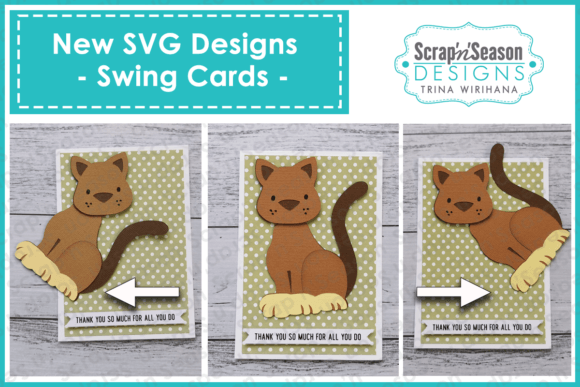
In the crowded landscape of the creative marketplace, visual hierarchy is everything. The Swing Card - Cat offers a significant advantage in product mockup creation. Because it is a 3D SVG structure, it naturally creates depth in listing images. When you photograph the assembled card, the shadow play and dimensionality immediately signal quality to the browser.
Using this asset allows for compelling visual storytelling. Instead of a flat thumbnail, a seller can showcase the "before and after" of the assembly process. This builds customer trust and demonstrates the functionality of the file. High-quality mockups featuring this card can increase click-through potential significantly. It helps establish brand identity for sellers who specialize in intricate paper crafts, positioning them as experts in structural design rather than just basic cut files.
Ideal Use Cases and Strategic Limitations
Knowing where to place this asset is just as important as knowing how to use it. The Swing Card - Cat shines in large product previews and themed bundles centered around pets or interactive stationery. It is ideal for digital downloads sold as premium items due to the complexity of the assembly. It works exceptionally well in decorative layouts where the mechanism is the star of the show.
However, caution is required in specific scenarios. This is not a file for tiny sticker details where the fine lines of the swing mechanism might get lost or bleed during printing. It should be avoided in overly complex layouts where the card competes with too much text, as the visual noise can confuse the buyer. Furthermore, using this on dark backgrounds without proper contrast adjustments can obscure the delicate cut lines. For Cricut or Silhouette users, clean cutting lines are paramount; if the SVG nodes are too dense, it may cause weeding issues for vinyl users, though it is generally optimized for cardstock.
Practical Seller Notes for Quality Control
Before listing any product based on the Swing Card - Cat, rigorous testing is non-negotiable. As a professional seller, I recommend the following workflow:
- Test Real Mockups: Do not rely solely on digital renders. Cut the file on actual cardstock to ensure the swing mechanism functions smoothly.
- Thumbnail Preview: Shrink the image to marketplace thumbnail size. Does the cat remain recognizable? Is the action of the swing clear?
- Background Checks: Verify how the design looks on both white and dark backgrounds to ensure versatility for different customer needs.
- Color Testing: Print test copies to check color fidelity, especially if offering a printed version.
- File Inspection: Open the SVG File includes base card cutting file, card mat layer, and character cutout pieces to make this Swing Card in your vector software. Ensure layers are named logically for the end user.
- Assembly Verification: The original notes suggest using foam dots for assembly at specific points to achieve the correct lift. Verify this instruction holds true with standard craft supplies.
- Font Pairing: Experiment with pairing the graphic with serif, sans serif, script, handwritten, and display fonts to create cohesive marketing materials.
- Licensing Confirmation: Always double-check the commercial license terms to ensure you are allowed to sell finished physical goods or derivative digital files.
In conclusion, the Swing Card - Cat is a robust graphic design asset for sellers targeting the paper crafting and handmade sectors. Its strength lies in its interactive nature and clear structural design. While it requires careful handling regarding scale and complexity, its potential for creating high-value Etsy products and engaging social media graphics makes it a worthy addition to a diverse portfolio of design assets. By treating it as a premium component rather than a commodity, sellers can maximize its return on investment.